
Every PCB line is a race against heat.
Every PCB line is a race against heat.
Dry film resist has to be annealed. Solder mask has to be cured. Conformal coatings have to dry before the next step. And all of it happens on boards where materials with very different thermal tolerances sit centimeters apart.
Convection ovens heat the air, then wait for the air to heat the board. That lag means sensitive elements soak in heat until the slowest one catches up.
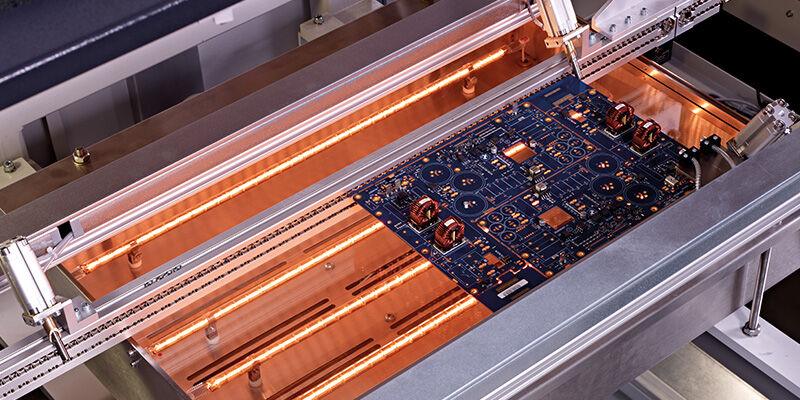
Short-wave infrared skips the wait. It transfers energy straight to the surface, so the board sees heat almost immediately, and the process stops just as fast when the lamp does. That’s what makes 2-second cure and dry cycles possible: less thermal soak, tighter process control.
But “IR lamp” on a spec sheet isn’t one answer.
What matters on a PCB line:
1. Wavelength matched to the material being cured. Resist, solder mask and conformal coating don’t absorb IR the same way.
2. Output that holds steady over the lamp’s life. A line at fixed speed can’t compensate for a lamp that’s quietly fading.
3. Length and voltage that fit the tunnel, not a generic size that gets shimmed in.
Get these wrong and the line doesn’t stop. It just starts producing more marginal boards: the ones that pass visual inspection and fail further down qualification.
We’ve spent 40+ years making halogen and infrared lamps to a customer’s exact wattage, voltage and length, built to spec rather than adapted to fit.
For PCB folks here: when a curing or drying lamp needs replacing, do you go back to the oven OEM’s spec, or source locally?
Visit Litex Electricals at litexelectricals.com to know how we can help.